For twenty years, getting found online meant one thing: ranking on Google. You optimised a page, earned some backlinks, and hoped to land in the top ten blue links.
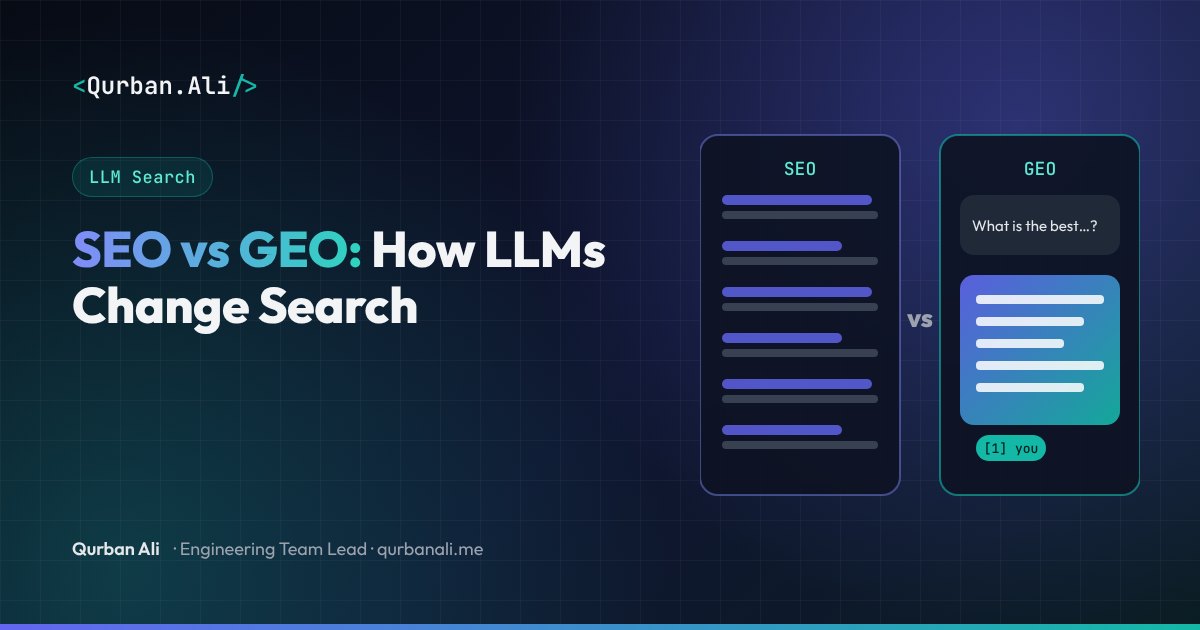
That model is changing. A growing share of people now ask ChatGPT, Gemini, Perplexity or Claude instead of typing keywords into a search box, and Google itself puts an AI Overview above the traditional results for many queries. The user no longer sees ten links and picks one. They read one written answer that cites a handful of sources.
That shift has a name: Generative Engine Optimization (GEO). Here's what it means, how it differs from classic SEO, and why you need both.
What is SEO?
Search Engine Optimization (SEO) is the practice of improving a web page so that search engines rank it higher for relevant queries. It focuses on:
- Relevance: matching the keywords and intent behind a search.
- Authority: backlinks and signals that other sites trust you.
- Technical health: fast, mobile-friendly, crawlable pages.
Success is measured in rankings, impressions and clicks.
What is GEO?
Generative Engine Optimization (GEO) is the practice of making your content easy for large language models (LLMs) to find, understand, trust and cite when they generate an answer.
The term was popularised by a 2023 research paper from Princeton and collaborators, "GEO: Generative Engine Optimization". The researchers tested how content changes affect visibility inside AI-generated answers and found that adding citations, quotations from credible sources and concrete statistics made content noticeably more likely to be used — while classic tactics like keyword stuffing did little.
You'll also hear related terms:
- AEO (Answer Engine Optimization): optimising to be the direct answer, originally for featured snippets and voice assistants.
- LLMO / LLM SEO: an informal umbrella for optimising content for LLM-powered tools.
They overlap heavily. GEO is the most widely used name today.
How LLM search actually works
Understanding the mechanics explains most GEO advice. When you ask an AI assistant a question that needs current or specific information, it typically:
- Rewrites your question into one or more search queries.
- Retrieves pages from a search index (its own or a partner's).
- Extracts the most relevant passages from those pages.
- Writes an answer grounded in those passages and cites the sources it used.
This is retrieval-augmented generation (RAG) — the same pattern many of us build into products. Two consequences follow:
- You still need to be retrievable. If search engines can't crawl and index your page, the AI can't find it. SEO is the entry ticket.
- Passages compete, not pages. The model lifts a clear definition, a list or a fact. A page that buries its answer in paragraph nine loses to one that states it in the first sentence.
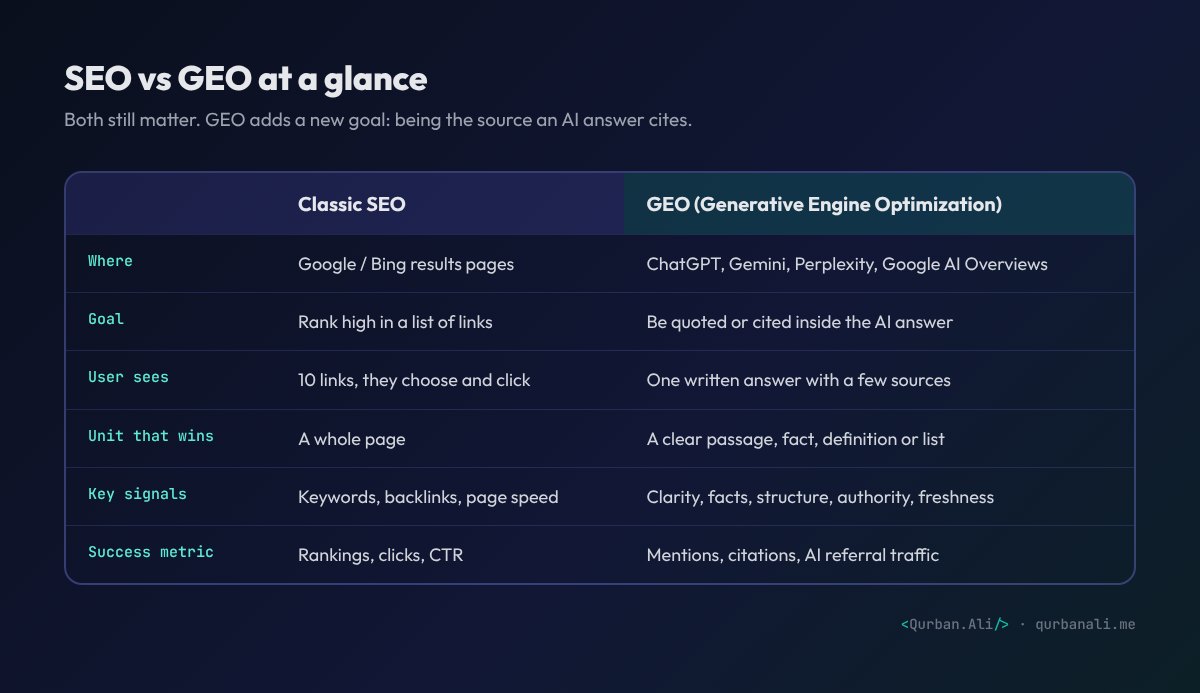
SEO vs GEO: the key differences
1. The goal changes from ranking to being cited. In SEO you compete for position. In GEO you compete to be one of the two or three sources the answer is built on.
2. Clarity beats cleverness. LLMs reward content that is easy to quote: direct answers, defined terms, numbered steps, comparison tables.
3. Evidence matters more. Specific facts, dates, original data and cited sources make a passage more useful — and more trustworthy — to a model assembling an answer.
4. Brand mentions matter, not just links. Models learn which brands and people are associated with which topics from across the web: reviews, forums, interviews, documentation. Being consistently mentioned in the right context helps.
5. Measurement is harder. There's no "position 1" in a chat answer, and answers vary between users and sessions. You track mentions, citations and referral traffic from AI tools instead.
Is SEO dead?
No. GEO builds on SEO rather than replacing it:
- AI assistants rely on search indexes to find fresh content.
- Pages that rank well are more likely to be retrieved and cited.
- Technical SEO — speed, crawlability, structured data — directly supports GEO.
The better framing: SEO gets you into the library; GEO gets you quoted.
What this means for businesses and developers
- Marketing teams need to write for answers, not just keywords.
- Developers need to make sure content is server-rendered, fast, well-structured and marked up with schema — and decide deliberately which AI crawlers to allow.
- Founders should start tracking how often their brand appears in AI answers for the questions their customers actually ask.
In the next article, I share a practical, step-by-step GEO playbook you can apply to your own site.
Want help making your product or content visible in AI search? Get in touch.