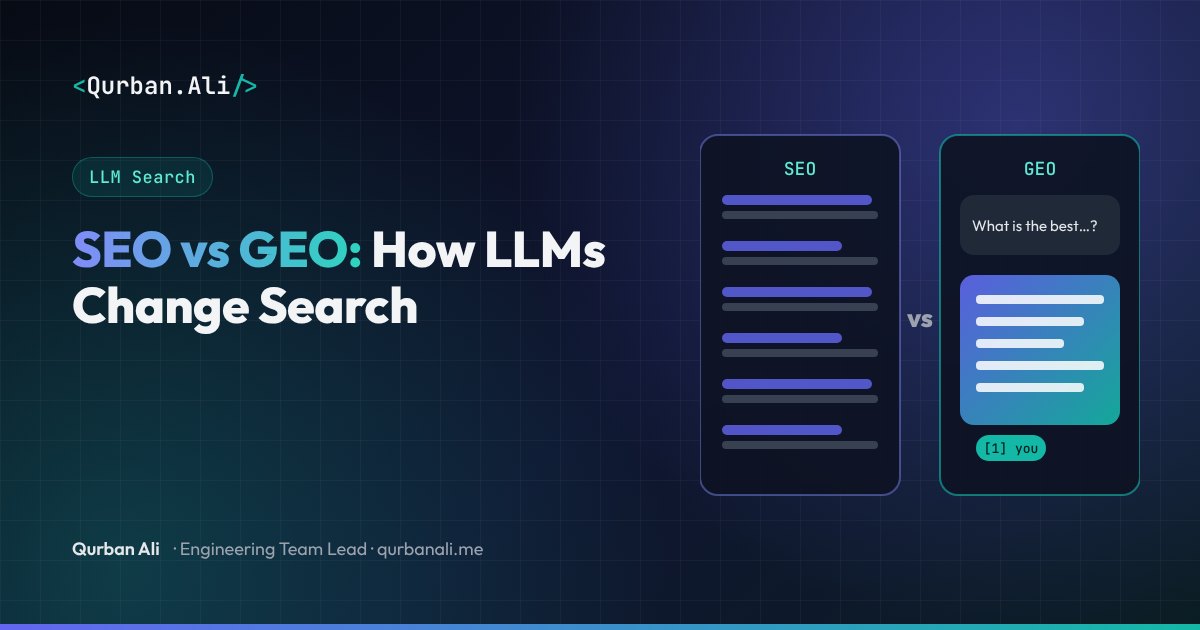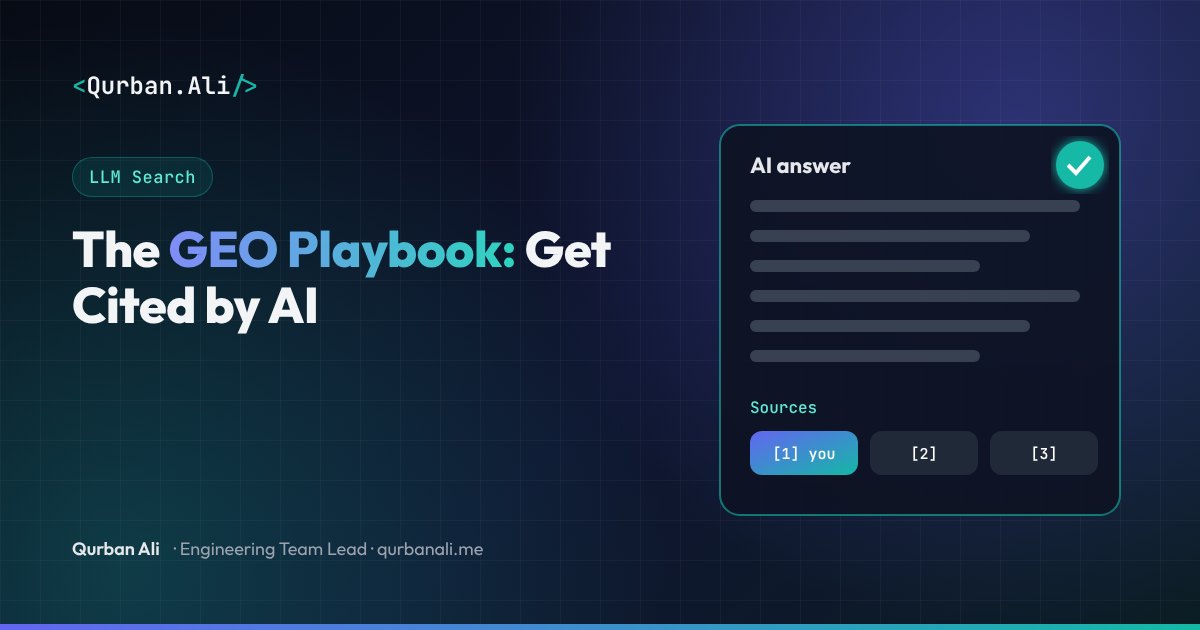
In my previous article I explained how Generative Engine Optimization (GEO) differs from classic SEO. This one is practical: what to actually change on your website so that ChatGPT, Gemini, Perplexity and Google's AI features are more likely to use and cite your content.
None of this is a trick. Every step also makes your content better for human readers — which is exactly why it works.
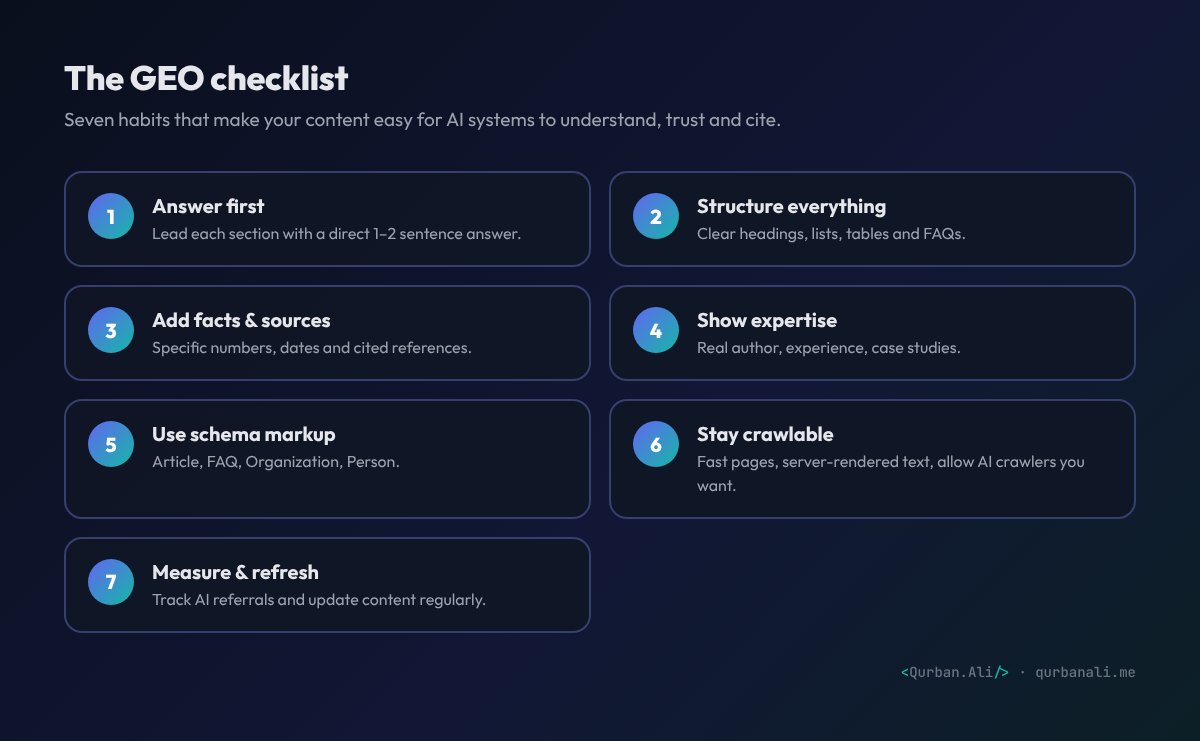
1. Answer first
AI systems extract passages, not whole pages. Make every important section quotable on its own:
- Start each section with a direct one- or two-sentence answer, then explain.
- Phrase headings the way people ask questions: "How much does a custom CRM cost?" rather than "Pricing Considerations".
- Define key terms explicitly: "RAG (retrieval-augmented generation) is…".
Before: "There are many factors to consider when thinking about timelines…"
After: "A typical MVP takes 8–12 weeks. The main factors are scope, integrations and team size."
2. Structure everything
Structure helps models understand what each part of a page is about:
- One clear H1, logical H2/H3 headings.
- Numbered steps for processes, bullet lists for options.
- Comparison tables for "X vs Y" questions — these are frequently reused in AI answers.
- A short FAQ section covering the follow-up questions customers really ask.
3. Add facts, data and sources
Generic content is interchangeable; specific content is citable. The original GEO research found that adding statistics, quotations and citations made content more likely to appear in generated answers.
- Use concrete numbers, dates and named examples.
- Link to primary sources for claims you didn't originate.
- Publish original data where you can: benchmarks, survey results, case-study outcomes. Unique facts are the strongest reason for a model to cite you.
4. Show real expertise
Models — and the search systems feeding them — look for signals that a real, qualified person stands behind the content:
- A visible author name, role and bio on every article.
- First-hand experience: "When we built X, we found Y."
- Case studies with real context, constraints and outcomes.
- Consistent profiles (LinkedIn, GitHub, company page) that connect the author to the topic.
5. Use structured data (schema markup)
Schema.org markup in JSON-LD tells machines exactly what a page contains. Start with:
Article/BlogPosting— title, author, publish and update dates.PersonandOrganization— who you are and how to reach you.FAQPage— for genuine Q&A sections.Product/Service— for offerings and pricing.
Validate it with Google's Rich Results Test.
6. Stay crawlable — for the right bots
If a crawler can't read your content, nothing else matters:
- Server-render important text. Content that only appears after heavy client-side JavaScript is harder for many crawlers to read.
- Keep pages fast and mobile-friendly.
- Maintain an up-to-date XML sitemap.
- Review
robots.txtdeliberately. AI companies publish their crawler names (for example OpenAI'sGPTBotandOAI-SearchBot, and Google'sGoogle-Extendedcontrol). Decide which ones you allow based on whether you want visibility in their products. - Optionally add an
llms.txtfile — a proposed convention that gives LLMs a concise, Markdown overview of your site. Support across AI tools is still inconsistent, so treat it as a low-cost extra, not a guarantee.
7. Measure and refresh
You can't improve what you don't track:
- Referral traffic: in your analytics, watch for visits from
chatgpt.com,perplexity.ai,gemini.google.comand similar. - Prompt testing: keep a list of 20–30 questions your customers ask and check monthly which brands and pages AI assistants mention.
- Freshness: update key pages regularly and show a visible "last updated" date — AI search favours current information.
A 30-day starter plan
| Week | Focus |
|---|---|
| 1 | List the top 20 questions customers ask; test them in 3 AI assistants and record who gets cited |
| 2 | Rewrite your 5 most important pages: answer-first sections, clear headings, an FAQ |
| 3 | Add schema markup, fix crawlability issues, review robots.txt |
| 4 | Publish one piece with original data or a detailed case study; set up AI referral tracking |
Common mistakes to avoid
- Keyword stuffing — it didn't help in the GEO research and it hurts readability.
- Hiding content behind tabs, logins or client-only rendering.
- Thin AI-generated filler — models are good at recognising content that adds nothing new.
- Chasing one tool. Optimise for clarity and evidence, and you improve across all of them.
Want me to audit your site for AI search visibility, or build GEO-friendly structure into your product? Let's talk.