Traditional code is deterministic: the same input gives the same output, and a unit test tells you if it's right. LLM features are different. Outputs vary, "correct" is often a matter of degree, and a small prompt change can quietly break cases that used to work.
That's why serious AI teams rely on evals — systematic tests for LLM behaviour. If you ship AI features without them, your users become your test suite.
What is an eval?
An eval is a repeatable test that runs your AI feature against a set of example inputs and scores the outputs against what good looks like.
Think of it as a unit test suite for prompts, models and retrieval pipelines. You run it:
- before changing a prompt,
- before switching or upgrading a model,
- before changing retrieval (chunking, embeddings, ranking),
- and regularly on production samples to catch drift.
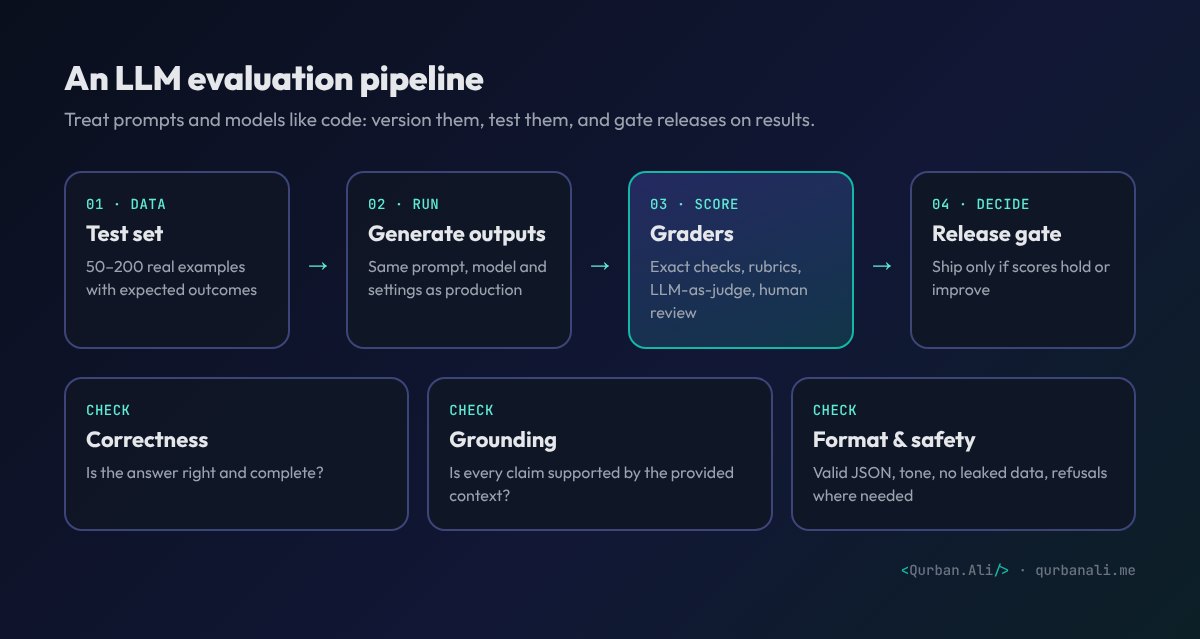
Step 1: Build a test set from reality
Start with 50–200 real examples, not invented ones:
- Common requests that make up most of your traffic.
- Edge cases — empty inputs, very long documents, mixed languages.
- Known failures from production or user feedback.
- Adversarial cases — attempts to make the model ignore instructions or reveal data.
For each example, record what a good output looks like: an exact answer, the facts it must contain, or a rubric.
When I worked on CV and job-description parsing, the most valuable test cases were the messy ones: two-column layouts, unusual job titles, CVs in mixed languages. Those are exactly where a prompt change breaks things.
Step 2: Choose the right graders
Use the simplest grader that works:
- Code-based checks — Is it valid JSON? Does it match the schema? Is the extracted date correct? Fast, cheap and reliable. Use them wherever possible.
- Reference comparison — Compare against a known answer, exactly or with similarity measures.
- LLM-as-judge — A model scores the output against a rubric ("Is every claim supported by the provided context? Score 1–5 with a reason."). Powerful for open-ended text, but validate the judge against human ratings before trusting it.
- Human review — Essential for calibration and high-stakes outputs. Review a sample regularly.
Step 3: Measure what matters
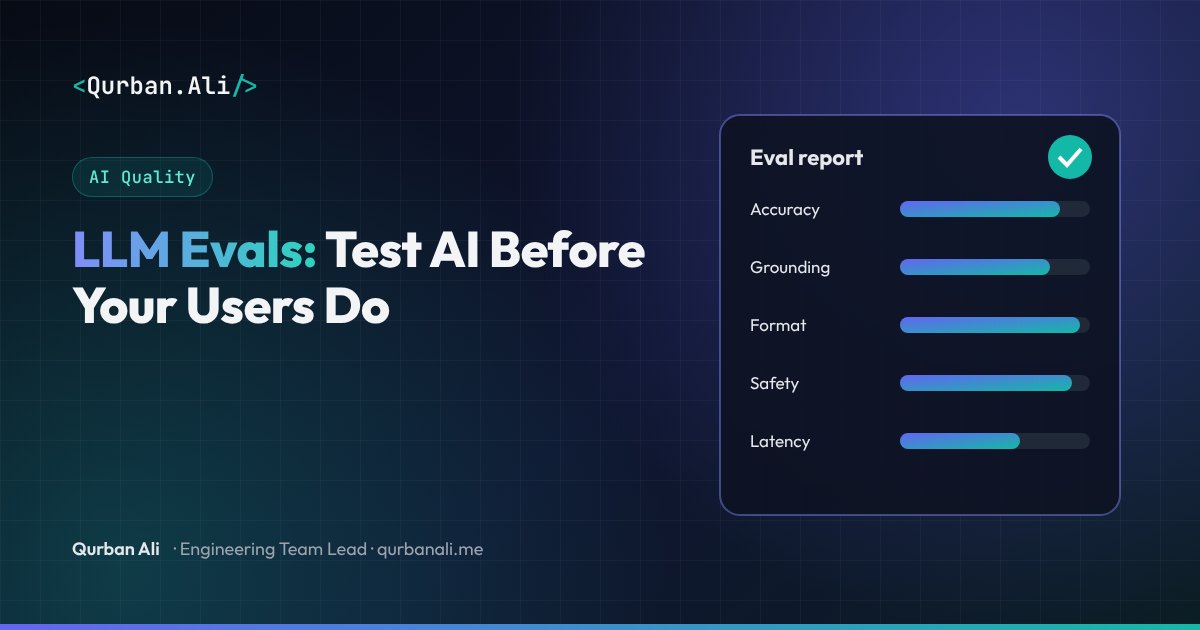
Typical dimensions:
- Correctness — is the answer right and complete?
- Grounding — for RAG, is every claim supported by retrieved sources?
- Format — does it follow the required structure?
- Safety — no leaked personal data, appropriate refusals, resistance to prompt injection.
- Cost and latency — quality that's too slow or expensive isn't shippable.
Step 4: Make evals a release gate
Evals are only useful if they influence decisions:
- Version prompts, model settings and test sets alongside your code.
- Run evals in CI for any change to prompts, models or retrieval.
- Compare against the baseline — ship only if scores hold or improve.
- Look at the failures, not just the average. A higher average can hide a new, serious failure.
Step 5: Keep learning from production
- Log inputs, outputs and user feedback (with appropriate privacy controls).
- Turn new failures into new test cases.
- Sample production traffic regularly for human review.
Over time, your eval set becomes one of the most valuable assets of your AI product — it encodes everything you've learned about what "good" means for your users.
The bottom line
You wouldn't ship backend code without tests. Don't ship prompts without evals. Start small — 50 real examples and a few code-based checks — and grow from there. It's the difference between hoping your AI feature works and knowing it does.
Need help making your AI features reliable and measurable? Get in touch.