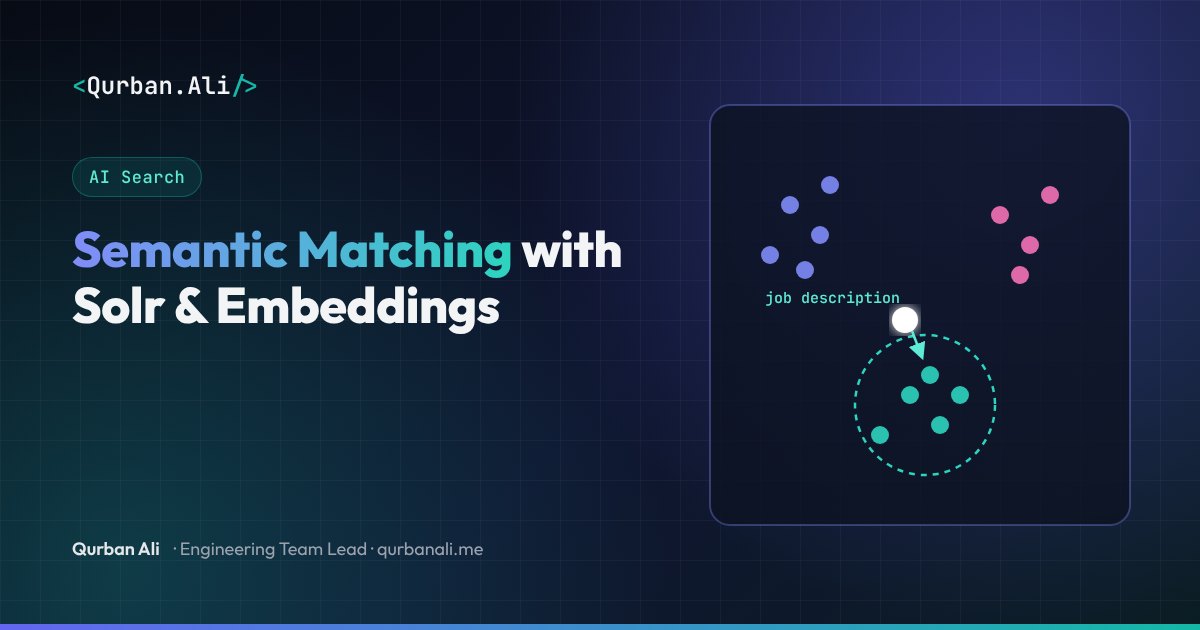
Recruiters rarely search for exactly the words a candidate wrote. A job description asks for "line maintenance experience on narrow-body aircraft", while a CV says "B1 engineer, A320 family, overnight checks". A keyword search misses that match. A semantic search finds it.
This post walks through the approach we used on recruitment platforms like SmartMatch and TalentVista.
1. Turn unstructured CVs into structured data
CVs arrive as PDFs and Word files in every possible layout. The first step is extraction:
- Convert the document to text.
- Ask an LLM (we used Google Gemini) to return a strict JSON schema: roles, years of experience, skills, certifications, education.
- Validate the JSON before saving it — never trust model output blindly.
Structured fields power filters ("at least 5 years", "has certification X"), while the full text feeds the semantic layer.
2. Generate embeddings for meaning, not keywords
Each CV and each job description gets converted into a vector embedding. Texts with similar meaning end up close together in vector space, even if they share few words.
A few practical lessons:
- Embed focused chunks, not the whole CV in one go — a summary, the experience section and the skills section work better separately.
- Store the model name and version with every vector. If you change models, old and new vectors are not comparable.
- Re-embed in background jobs so uploads stay fast.
3. Index and search with Apache Solr
Solr supports dense vector fields alongside its classic text search. That lets one query combine:
- Hard filters — location, availability, certifications.
- Vector similarity — how close the candidate is in meaning to the job description.
- Keyword boosts — exact terms the recruiter insists on.
Combining all three gives far better results than any one of them alone.
4. Explain the score
A number like "87% match" is not enough for a recruiter to trust. We used an LLM to write a short explanation for each top candidate: matching strengths, potential gaps, and questions worth asking in the interview. This is retrieval-augmented generation (RAG) — the model only reasons over the retrieved candidate data, not its general knowledge.
What to watch out for
- Bias: keep the scoring criteria transparent and let humans make the final decision.
- Cost: embeddings are cheap, LLM explanations are not — generate them only for the shortlist.
- Privacy: CVs are personal data. Restrict who can see them and how long you keep them.
Building something similar? Get in touch — I'm happy to talk through your use case.