On 26 October 2026, Reuters published a story with a blunt headline: "In China, the AI bubble has already burst." While investors elsewhere still debate whether AI valuations have gone too far, China's AI-heavy stock market has already lived through a sharp fall.
I'm an engineer, not an investor, so this isn't financial advice. But the story contains useful lessons for anyone building products with AI — because a stock-market bubble and the technology itself are not the same thing.
What happened
According to the Reuters report:
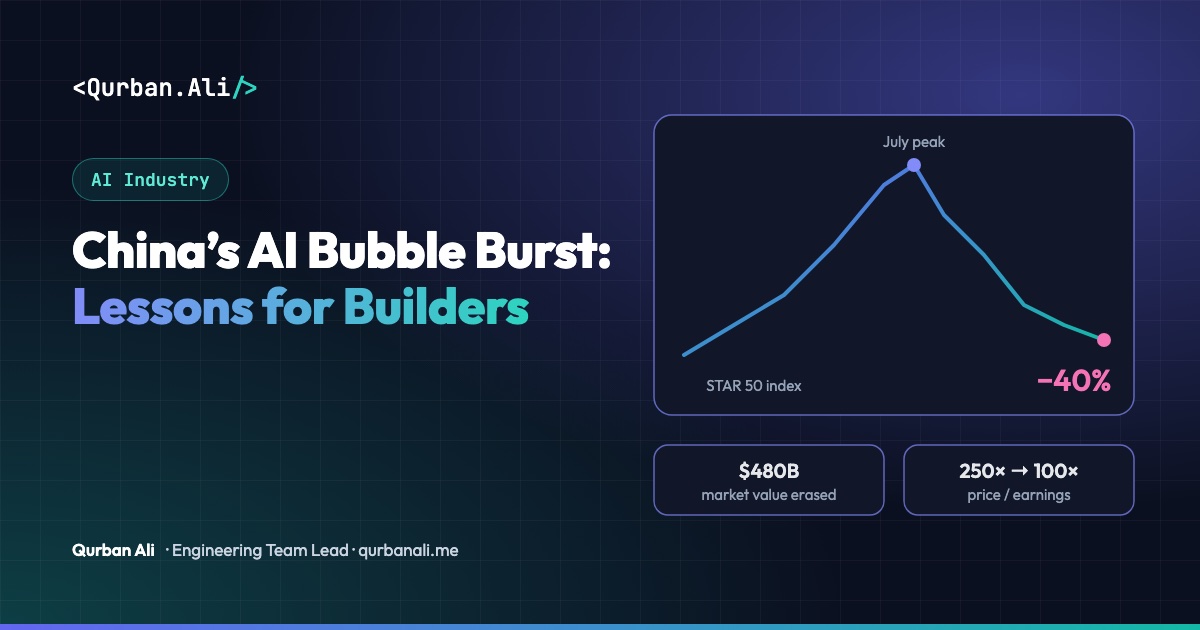
- China's STAR 50 index of AI and chip stocks fell about 40% in under four months, wiping out roughly $480 billion of market value. The blue-chip CSI 300 fell around 20% from its June peak.
- AI stocks had grown to about 42% of market capitalisation and 57% of turnover across mainland and Hong Kong shares, according to Goldman Sachs.
- At its peak the STAR 50 traded at nearly 250 times trailing earnings; even after the fall it's around 100 times, against roughly 30 for the Nasdaq 100.
- High-profile listings fell hard: robot maker Unitree, whose share offering was 8,000 times oversubscribed by retail investors, has halved since its August debut. GPU makers MetaX and Moore Threads each lost about half their value since July. Optical-component makers Zhongji Innolight and Eoptolink dropped about 60%, partly because Washington is moving to bar them from supplying US data centres.
- Traders pointed to no single trigger: stretched valuations, tax bills, doubts about AI demand and export restrictions all played a part. State-backed investors also sold into rallies, as Beijing aims for a steadier "slow bull" market.
One Beijing fund manager told Reuters the market had turned into a speculative bull run and that the bubble was now bursting.
What it doesn't mean
A collapse in share prices is not a collapse in usefulness. The internet survived the dot-com crash; what didn't survive were companies with no path to profit. The same models, tools and techniques that worked last month still work today — and capital continues to flow to strong teams: DeepSeek, for example, recently raised a reported $15 billion.
What a correction does change is the environment around builders: funding gets harder, weak vendors disappear, and buyers start asking hard questions about return on investment.
Lessons for teams building with AI
1. Build on problems, not hype. The AI features that survive a downturn are the ones that save measurable time or money: invoice processing, support triage, search, document extraction. If you can't state the business result in one sentence, rethink the feature.
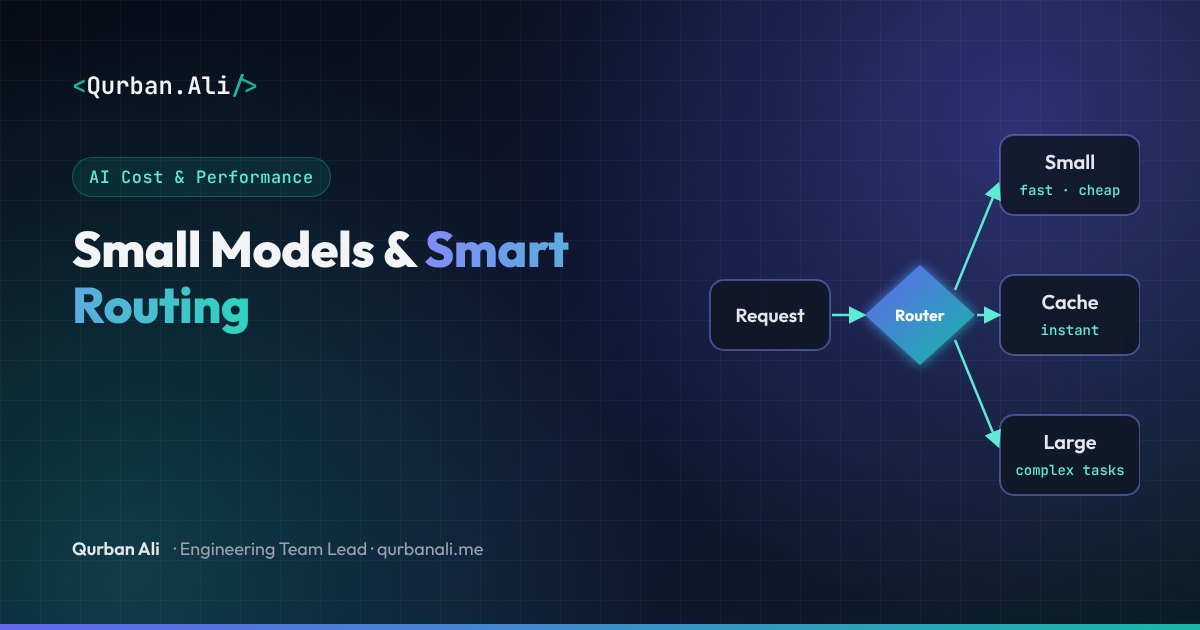
2. Know your unit economics. Track the cost per task — model tokens, retrieval, infrastructure — against the value it creates. Use the smallest model that meets your quality bar and route only hard cases to larger ones.
3. Reduce vendor risk. Startups you rely on may be acquired, change pricing or shut down. Keep a thin abstraction between your code and any single model provider, store your prompts and evaluation sets in your own repository, and make sure you can export your data.
4. Make quality measurable. Evaluation sets turn "the AI seems good" into numbers. When budgets tighten, the team that can prove accuracy and savings keeps its funding.
5. Watch geopolitics in your supply chain. Export controls and data-centre restrictions now affect which chips, clouds and models you can use. Where you host, which provider you choose and where your data lives are becoming business-continuity decisions.
The bottom line
Markets swing between excitement and fear; useful technology keeps compounding underneath. China's correction is a reminder to judge AI projects the way we judge any engineering investment: clear problem, measurable value, controlled cost and no single point of failure. Teams that work this way do fine whichever way the market moves.
Sources: Reuters via The Kathmandu Post: "In China, the AI bubble has already burst" · Futurism · Yahoo Finance
This article is commentary for technology teams, not investment advice.
Planning AI features with clear ROI? Let's talk.